Your Reading List Is a Graveyard and You Keep Adding Tombstones
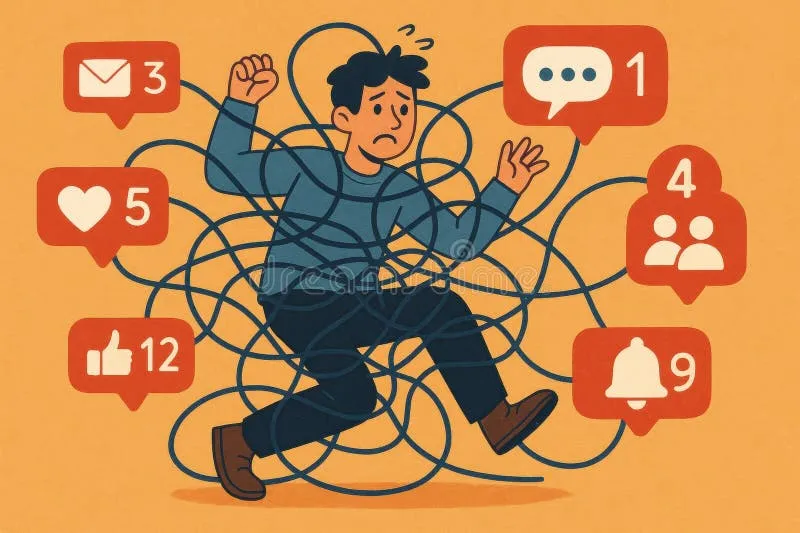
Photo: overwhelmed person looking at phone with too many notifications bookmarks digital clutter, via thumbs.dreamstime.com
Somewhere in your browser, your phone, or your Notion workspace, there is a list. Maybe it's a Pocket queue with 340 articles. Maybe it's a Notes folder called "READ THIS" stuffed with links from 2021. Maybe it's a Safari reading list so bloated it takes three seconds to load. Whatever shape it takes, you know exactly what it is: a monument to your best intentions and your worst follow-through.
You are not alone. And you are not lazy. But you are caught in one of the most quietly destructive traps of the information age — and the trap is so well-designed that breaking free requires understanding exactly why you fell in.
The Save Button Is a Lie Your Brain Tells Itself
Here's the thing about bookmarking an article: it feels productive. There's a small but real sense of accomplishment that comes with tapping that little ribbon icon, dragging a link into a folder, or screenshotting a tweet thread. You found something worth keeping. You made a decision. You did something.
Except you didn't read it.
Psychologists call this "completion substitution" — the tendency to treat the act of organizing or storing information as a proxy for actually engaging with it. Your brain gets a mild dopamine hit from the save action itself, which effectively tricks your reward system into thinking the task is done. The article is handled. Move on.
This is the foundation of what researchers sometimes call "intention stacking" — layering so many planned future actions on top of each other that none of them ever get executed. Every saved article is a tiny promise you made to yourself. Stack five hundred of those promises and you don't have a reading list. You have an anxiety machine.
Why Unlimited Storage Made Everything Worse
For most of human history, you couldn't hoard information at scale. You could dog-ear a page, tear out a newspaper clipping, or scribble a title on a napkin. Physical constraints forced prioritization. If you only had room for ten things on your nightstand, you thought hard about which ten things mattered.
Then came infinite cloud storage, one-tap saving, and algorithms specifically designed to surface content worth bookmarking. Suddenly the friction disappeared. Saving something costs nothing — no space, no money, no time. And when something costs nothing, we treat it like it's worth nothing. We save recklessly because there's no penalty for saving recklessly.
The result is a kind of digital hoarding that doesn't look like hoarding because the clutter is invisible. Your apartment isn't full of newspapers. Your phone just has 847 saved posts from Instagram and a Substack inbox you haven't opened since March.
The Illusion of Curation
There's a particular flavor of self-deception that affects people who think of themselves as curious, well-read, or intellectually engaged — and it goes like this: I save good stuff. Therefore I am someone who consumes good stuff.
The saved list becomes a mirror that reflects the person you intend to be. It's full of long-form journalism, book recommendations, explainers about macroeconomics and climate policy and the history of jazz. Looking at it feels like looking at a well-stocked library. Impressive. Aspirational.
But a library you never open isn't a library. It's a set.
The curation itself becomes the hobby, not the reading. You get skilled at finding things worth saving. You develop taste in what to bookmark without ever developing depth in any of the subjects those bookmarks represent. It's the intellectual equivalent of following a hundred cooking accounts on Instagram and never making dinner.
What Actually Happens When You Try to Catch Up
Most people who recognize this pattern eventually attempt a purge. They set aside a Saturday afternoon to "get through" their reading list. They open the first article, read two paragraphs, realize it's from 2022 and completely dated, close it, and feel vaguely defeated. They try the next one. It's fine. They get distracted. They abandon the project by 3 p.m. and save three new articles before dinner.
The catch-up model doesn't work because it misunderstands the problem. The problem isn't that you haven't had time to read your list. The problem is that the list was never designed to be read. It was designed to grow.
Breaking the Cycle Without Burning Everything Down
So what actually works? A few things — none of them glamorous, all of them effective.
Read it now or delete it. This is the nuclear option, and it's also the most honest one. When you encounter something worth reading, read it immediately or accept that you probably never will. The "save for later" move should be reserved for situations where you are literally unable to read in that moment — on a call, driving, mid-conversation. Not "I'll get to this tonight" which is code for never.
Cap your queue at ten. If you do maintain a reading list, treat it like a physical inbox with a hard limit. Ten items maximum. When something new comes in, something old has to go — either you read it right now, or you delete it to make room. Constraints create decisions. Decisions create action.
Separate saving from reading. Tools like Instapaper or Readwise are genuinely useful, but only if you schedule dedicated reading time with the same seriousness you'd give a meeting. Not "sometime this week." Tuesday at 7 p.m. for 30 minutes. On the calendar. With your phone face-down.
Ask a better question before you save. Instead of "is this interesting?" — which almost everything is, at least for a moment — ask "will I actually read this in the next 48 hours?" If the honest answer is no, let it go. The internet will not run out of interesting things. You are not saving a rare artifact. You're hoarding a commodity.
Do a quarterly delete, not a quarterly catch-up. Every few months, go through your saved list and delete everything older than 30 days without reading it. Don't feel guilty. Feel honest. If you haven't read it in a month, you're not going to read it. The delete button is not failure — it's clarity.
The Actual Goal Here
At House of Summary, we believe deeply in the value of condensed, curated content — the right idea delivered efficiently, without waste. But there's a version of that philosophy that goes wrong, and it looks like a Pocket queue with 500 articles and a reader who hasn't actually learned anything new in six months.
The goal was never to collect information. The goal was to absorb it. To let it change how you think, what you know, what you do. A summary you actually read is worth a thousand long-form pieces you saved and forgot.
Your reading list should be a door, not a storage unit. Walk through it or stop building it.
The tombstones can wait. The reading can't.