Your Brain Forgets on Purpose — And It's Smarter Than Your Note-Taking App

Photo: Manaku, CC0, via Wikimedia Commons
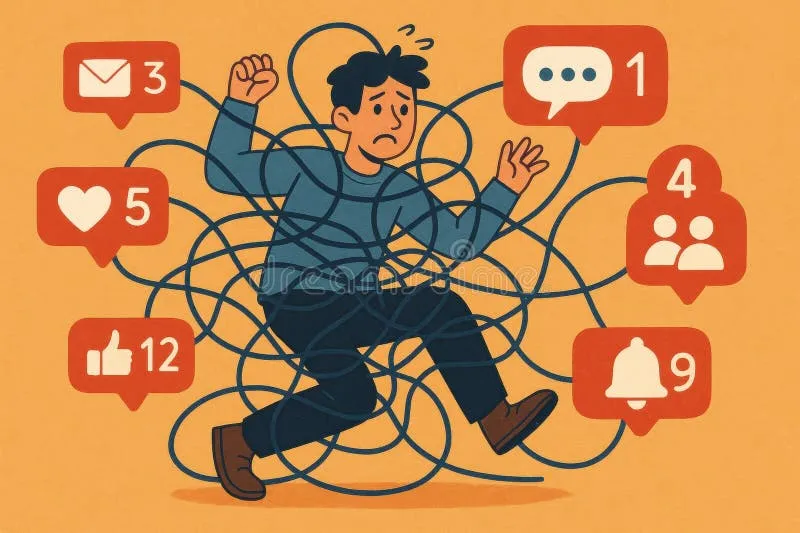
Somewhere on your phone right now, there's a screenshot you took eight months ago of a quote that felt life-changing. You have no idea what's in it. There's also a Notion database you built with color-coded tags and nested folders that hasn't been opened since March. And don't get started on the voice memos — seventeen of them, all labeled "important idea" with no further context.
We are drowning in our own attempts to remember everything.
The productivity world sold us a story: the brain is leaky, unreliable hardware, and the fix is better external storage. More apps. Better systems. Tighter capture workflows. The goal, implicitly, became perfect recall — a frictionless pipeline from incoming information to retrievable knowledge. Zero loss. Maximum retention.
There's just one problem. That's not how intelligence actually works.
Forgetting Isn't Failure — It's Filtration
Cognitive scientists have known for decades that forgetting is not a malfunction. It's a design choice. The brain doesn't passively lose information the way a hard drive corrupts data. It actively prunes, deprioritizes, and discards — and it does so with something resembling judgment.
Researchers at the University of Toronto, including neuroscientist Blake Richards, have argued that the goal of memory isn't perfect retention. It's optimal decision-making. The brain holds onto patterns, generalizations, and emotionally significant experiences. It lets go of the granular stuff — the exact wording, the specific timestamp, the verbatim detail — because that level of noise actually gets in the way of clear thinking.
Think about how you navigate your hometown versus a city you visited once. In your hometown, you don't remember every individual trip to the grocery store. You remember the route. Your brain compressed thousands of specific memories into one useful abstraction. That compression? That's not memory failure. That's memory doing exactly what it's supposed to do.
When we outsource all of that compression to apps and systems, we're not augmenting our intelligence. We're quietly opting out of the process that builds it.
The Struggle Is the Point
Here's something that doesn't get enough airtime in productivity circles: the act of trying to remember something is cognitively valuable in a way that instantly retrieving it is not.
Psychologists call it the "retrieval practice effect" or, more colloquially, the testing effect. When you strain to recall something — when you sit with the discomfort of not quite having it — your brain strengthens the neural pathway associated with that memory. The struggle itself is the workout. Easy access skips the gym entirely.
This is part of why students who reread their highlighted notes often perform worse on exams than students who close the book and try to recall what they just read from scratch. Highlighting feels productive. It looks like learning. But the friction of retrieval is where actual retention happens.
Now scale that up. If every insight you've ever encountered is one search query away in your personal knowledge management system, you never have to struggle to retrieve anything. And if you never struggle, you never strengthen. Your external system gets smarter. You don't.
The Creativity Tax on Perfect Capture
There's another cost that's even harder to measure: creative connection.
Some of the best ideas humans have ever had came from two seemingly unrelated things bumping into each other inside someone's head at the right moment. Darwin synthesizing animal breeding practices with population pressure. Steve Jobs connecting calligraphy classes to typography in personal computing. These weren't database queries. They were collisions — the kind that only happen when information has been rattling around loosely, half-forgotten, waiting for something else to activate it.
When everything is captured, tagged, and filed, it stops rattling. It sits inert in its folder, perfectly labeled, perfectly still. The organizational system that was supposed to make you more creative has effectively put your ideas in solitary confinement.
Psychologist Robert Bjork, one of the leading researchers on memory and learning, has a term for this: desirable difficulty. The idea that introducing friction into learning — spacing things out, varying the context, letting some forgetting happen — actually produces stronger, more flexible understanding than smooth, frictionless study ever could. We've been optimizing for the wrong outcome.
What the Summary Culture Gets Right (And Where It Stops)
Look, there's a reason platforms like this one exist. Nobody has time to read everything. The information landscape in 2025 is genuinely overwhelming, and condensed formats serve a real purpose — they help you decide what's worth your full attention, give you a working vocabulary for conversations, and surface ideas you wouldn't have found otherwise.
But even here, there's a version of the trap. If you consume summary after summary and never sit with the discomfort of incompleteness — never let a half-remembered idea nag at you for a few days — you're using curation as a substitute for thinking rather than a gateway to it.
The best use of a summary isn't to replace the cognitive work. It's to start it. Read the condensed version, then let it go a little. See what sticks. See what your brain decides is worth holding onto. That residue — the stuff that won't leave you alone — is actually telling you something important about what to pursue next.
Trusting the Process Your Brain Already Has
None of this means you should delete your note-taking apps or stop writing things down. Writing is thinking. Externalizing ideas has real value. The problem isn't the tools — it's the belief system underneath them.
The belief that forgetting is always bad. That more capture equals more intelligence. That the goal is a frictionless, lossless system that holds everything so you never have to hold anything yourself.
Your brain is not broken because it forgot the third bullet point in that article you read last Tuesday. It made a call. And statistically, it was probably right.
The most effective thinkers aren't the ones with the best filing systems. They're the ones who've learned to trust the messy, lossy, occasionally frustrating process of human memory — and who understand that the gaps are sometimes exactly where the good stuff grows.
Forget perfectly. Think better.