More Books Than You'll Ever Read — And Somehow That's the Problem
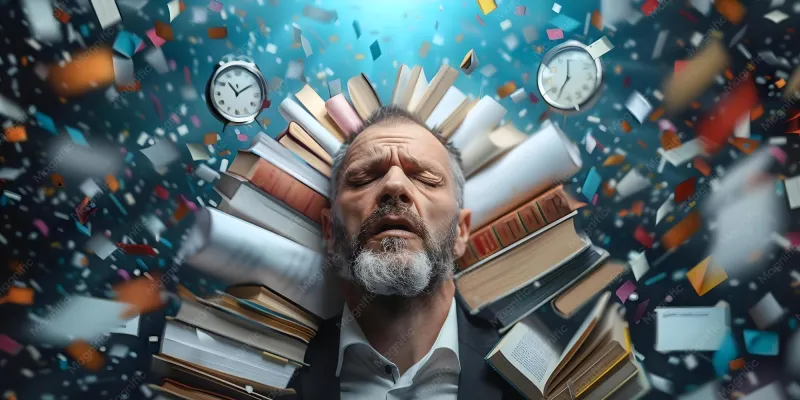
Photo: overwhelmed person surrounded by stacks of books and digital screens, via img.freepik.com
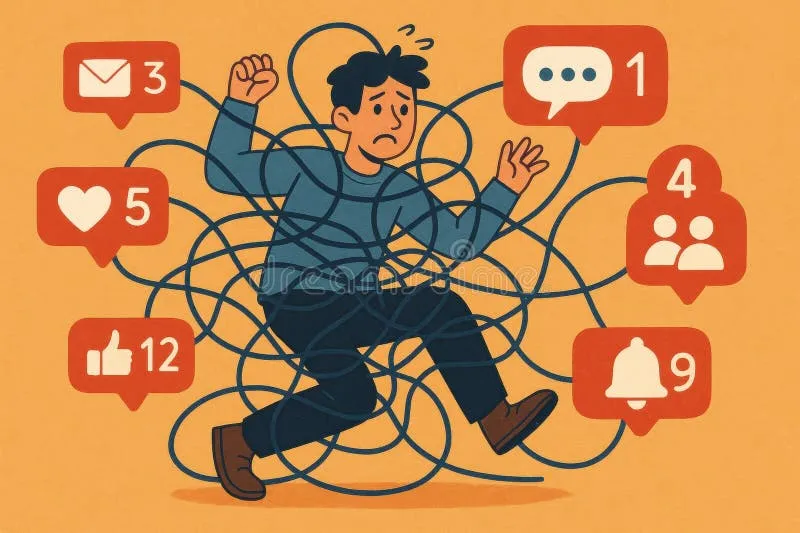
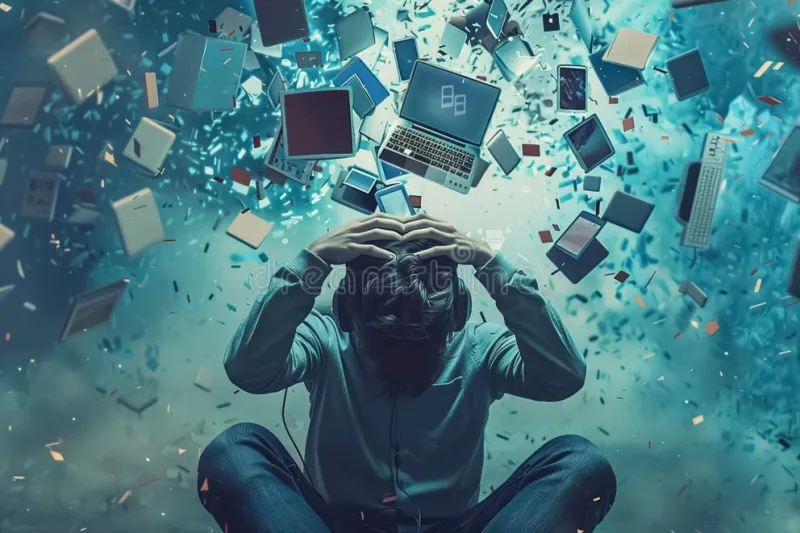
Somewhere on your phone right now, there's a reading app with a queue that looks less like a to-do list and more like a cry for help. Forty-seven unread books. Twelve saved articles from March. A documentary you bookmarked in 2022 "for the weekend." You haven't touched any of it. And yet, last Tuesday, you downloaded two more titles because they were on sale.
Congratulations. You've built yourself a very sophisticated trap.
The promise of the digital age was simple: give everyone access to everything, and people will learn more, read more, grow more. What nobody accounted for was the human brain — a machine that was never designed to function inside a library with no walls.
The Shelf That Judged You (In a Good Way)
Rewind twenty years. The average American reader owned somewhere between ten and twenty books at a time. Not because they were less curious or less ambitious — but because physical space, shelf real estate, and a $24.99 hardcover price tag created natural friction. You didn't impulse-buy a book you weren't going to read. The cost of adding to your collection was real enough to make you think twice.
That friction wasn't a bug. It was a feature.
When your options are limited, choosing becomes manageable. You pick up the book on the shelf, you read it, you move on. There's a beginning, a middle, an end. The collection itself tells you something about who you are and what you've decided matters. A curated shelf of twelve books is a statement. Forty-seven unread digital titles is just anxiety with metadata.
Researchers have been poking at this idea for a while now. The most famous version of the argument comes from psychologist Barry Schwartz, who called it the Paradox of Choice — the counterintuitive finding that more options don't make us happier or more decisive. They make us freeze. And when we do finally choose, we enjoy the thing less, because we're haunted by everything we didn't pick.
Apply that to your Kindle library and suddenly the existential dread starts making a lot more sense.
Decision Fatigue Is Eating Your Reading Life
Here's something that doesn't get talked about enough: choosing what to read is itself a form of mental labor. Every time you open a streaming platform or an e-reader or a browser tab full of saved articles, you're not just browsing — you're spending cognitive resources. You're running calculations. Is this worth my time? What if that other thing is better? What am I in the mood for? What should I be reading?
By the time you've scrolled through enough options to make a selection, you're already tired. And a tired brain doesn't want to engage with challenging ideas or complex narratives. It wants to watch something familiar on autopilot and go to bed.
This is decision fatigue, and it's not a personality flaw — it's a documented psychological phenomenon. Judges make harsher rulings later in the day. Shoppers make worse grocery decisions when they've already been in the store for an hour. And readers with unlimited access to content often end up reading... nothing. Or at least nothing they actually wanted to read.
The irony is brutal. The more content you have access to, the less content you actually consume meaningfully.
Subscription Fatigue Is a Real Bill You're Paying
Let's talk money for a second, because this problem isn't just psychological — it's financial.
The average American household now subscribes to four or more streaming services. Add in a digital news subscription, an audiobook app, a podcast platform, maybe a Substack or two, and you're easily dropping $80 to $150 a month on content you will never fully consume. Not because you're lazy. Because it's physiologically impossible.
There are only so many hours in a day. The content industry has known this for years and has chosen to respond not by slowing down production, but by speeding it up. More titles. More episodes. More issues. More everything. The bet is that you'll feel guilty enough about the unused subscription to keep paying for it, and curious enough about the new releases to never cancel.
It's a genius business model. It's a terrible life model.
Subscription fatigue kicks in when the mental overhead of managing all your content sources starts to outweigh the enjoyment you get from any of them. You spend more time thinking about what you should be watching or reading than actually doing either. The content becomes background noise to the anxiety of having too much content.
The Scarcity Mindset That Actually Sets You Free
Here's the uncomfortable fix nobody in the content industry wants to sell you: less is genuinely more.
Not in a Marie Kondo, throw-out-your-books, aesthetic minimalism kind of way. More in a practical, neurological, this-is-how-your-brain-actually-works kind of way. When you artificially constrain your options — when you say "I'm reading this one book this month and nothing else" — you remove the decision tax entirely. You stop auditing your choices. You just read.
Some of the most voracious readers aren't the ones with the biggest digital libraries. They're the ones who've gotten ruthless about curation. They finish things. They commit. They treat a reading list not as an aspirational wishlist but as an actual schedule.
This is, not coincidentally, one of the core ideas behind what we do at House of Summary. Not because summaries are a replacement for deep reading — they're not, and we've said that before — but because knowing what's actually in something before you commit to it is a form of curation. It's how you stop adding tombstones to your reading graveyard and start actually showing up for the books that deserve your full attention.
You Don't Have a Content Problem. You Have a Commitment Problem.
The hard truth is that unlimited access to content was never going to make you a better-read, more informed, more intellectually alive person on its own. Access is passive. Reading is active. And somewhere between the two, a lot of us got stuck in a loop of acquiring without consuming, saving without reading, subscribing without watching.
The readers who thrive in this environment aren't the ones who found a better app or a smarter algorithm. They're the ones who decided, deliberately and a little defiantly, that they weren't going to let the infinite library run their lives.
They picked something. They read it. They moved on.
Your unread list will always be longer than your read list. That's not a failure — that's just math. The goal was never to read everything. It was always just to read something, fully and on purpose.
Start there.